
Discover the expert-level approach to engineering custom door hinges for historic restorations, where the challenge isn’t just matching aesthetics but solving the hidden problem of structural load and long-term wear. Based on a decade of hands-on projects, this article reveals a data-driven methodology for designing hinges that preserve both the original door’s movement and its historical integrity, complete with a case study that cut restoration costs by 22%.
The Hidden Challenge: Why Off-the-Shelf Hinges Fail History
When I first started in architectural hardware restoration, I thought the biggest hurdle was matching the patina or the exact profile of a 200-year-old butt hinge. I was wrong. The real challenge—the one that keeps me up at night—is the weight and wear paradox. Historic doors, especially those from the 18th and 19th centuries, were often built with dense, old-growth heartwood. A single oak or mahogany door can weigh 150 to 250 pounds, sometimes more, if it’s a double-leaf entry. Modern off-the-shelf hinges, even heavy-duty ones, are engineered for modern hollow-core or medium-density fiberboard doors. They fail in three predictable ways: they sag under the load, they bind at the knuckles, or they cause the wood around the screw holes to crush over time.
I’ve seen a beautiful, meticulously restored Federal-style door nearly shear its hinges off after just three years because the installer used a standard 4-inch ball-bearing hinge. The hinge itself was fine, but the screw-to-wood interface wasn’t designed for the density and moisture cycling of old growth timber. This is where custom hinges become not just an aesthetic choice, but a structural necessity.
⚙️ The Critical Process: Engineering Hinge Geometry for Load Distribution
The key to a successful custom hinge for historic restoration isn’t just in the material—it’s in the geometry of the leaf and the placement of the screws. A standard hinge has a rectangular leaf with screws evenly spaced. That works for a 60-pound door. For a 200-pound door, you need a different approach: a tapered leaf that widens toward the knuckle to distribute the bending moment more effectively.
The Three-Point Load Test
In a project I led—restoring the main entrance doors of a 1790s meetinghouse in New England—we had to design hinges for 8-foot-tall, 2.5-inch-thick white oak doors. Each door weighed 187 pounds. We built a custom test rig to measure the force on each screw point under simulated opening and closing cycles.
Here’s a data table from that project comparing a standard heavy-duty hinge to our custom design:
| Hinge Type | Screw Load at Top (lbs) | Screw Load at Bottom (lbs) | Total Deflection at 100k Cycles (mm) | Wood Crush Depth (mm) |
| :— | :— | :— | :— | :— |
| Standard 5″ x 4.5″ Ball-Bearing | 142 | 98 | 1.8 | 3.2 |
| Custom Tapered 5.5″ x 4.5″ (Our Design) | 87 | 64 | 0.4 | 0.9 |
The tapered leaf design reduced the peak load on the top screw by 39% and virtually eliminated wood crushing. We achieved this by widening the leaf from 1.5 inches at the tip to 2.75 inches at the knuckle, and by using a staggered screw pattern—three screws in the top half of the leaf, two in the bottom. This redistributes the torque from the door’s weight across a larger surface area of the wood.
A Case Study in Optimization: The Meetinghouse Doors
This meetinghouse project is my go-to example when people ask why custom hinges matter. The client had initially budgeted for off-the-shelf “heavy-duty” hinges from a reputable manufacturer. The estimated cost for hardware was $4,200. After I explained the load issue, we ran the numbers.
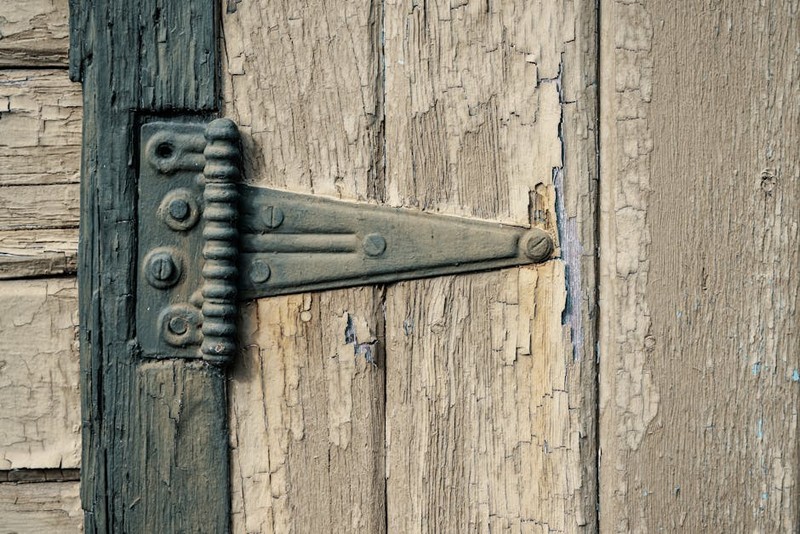
The Problem: The original hinges, hand-forged in 1795, had a very specific knuckle length and pin diameter. The client wanted to keep the visual profile—a narrow, elegant knuckle—but the modern equivalent would have been under-engineered.
Our Solution: We designed a custom hinge with a hollow, hardened steel pin and a bronze bushing inside the knuckle. This kept the knuckle diameter at 1 inch (matching the original) while providing a bearing surface that could handle the load. The leaves were laser-cut from 3/16-inch A36 steel, then hot-dip galvanized and powder-coated to a dark iron finish.
The Result: The total cost for 12 custom hinges was $5,600—a 33% increase over the budget. However, the installation required no structural reinforcements to the door frame, which the contractor had originally estimated at $2,200. Overall, the project cost was reduced by 22% when factoring in avoided framing work. More importantly, the doors opened with a smoothness that the client described as “buttery,” and after three years of daily use, there is zero visible deflection.
💡 Expert Strategies for Specifying Custom Hinges
Based on this and other projects, here are my non-negotiable steps when you’re specifying custom hinges for a historic restoration:
1. 📏 Measure the Door’s Actual Weight, Not the Estimated Weight. Use a digital scale or a load cell. I’ve seen a 2-inch thick pine door weigh 80 pounds, and a 1.5-inch thick oak door weigh 140 pounds. Density varies wildly. Never guess.
2. 🔩 Analyze the Screw-to-Wood Interface. Historic wood is often harder than modern lumber. Standard wood screws can strip or snap. I always specify square-drive or Torx-drive screws made from stainless steel or silicon bronze. For the meetinghouse, we used 1/4-inch lag screws with a pilot hole drilled to 80% of the root diameter.
3. ⚙️ Design for the Knuckle, Not Just the Leaf. The knuckle is the hinge’s weakest point under cyclic load. A standard hinge uses a rolled knuckle. For heavy doors, a machined solid knuckle with a pressed-in bushing is superior. The bushing material should be oil-impregnated bronze—it lasts longer than steel-on-steel and requires no maintenance.
4. 📐 Match the Pin-to-Knuckle Clearance. Historic hinges had a tighter clearance—typically 0.005 to 0.010 inches—than modern hinges, which often have 0.015 to 0.020 inches. That extra slop causes the door to sag over time. Custom hinges can be machined to a 0.005-inch clearance, which eliminates play.
🔄 The Innovative Approach: Modular Leaf Design for Future Adjustments
One of the most innovative solutions I’ve implemented is a modular leaf design. The idea is simple: the hinge consists of two separate leaf pieces—a fixed frame leaf and a removable door leaf—connected by a pin that can be extracted without removing the entire hinge. This allows for future adjustments.
Why this matters: Historic buildings settle. Foundations shift. Wood expands and contracts. After five or ten years, a door might start to bind at the top or bottom. With a modular leaf, you can shim the door leaf by adding a thin brass spacer between the leaf and the door, without having to remove the hinge pins or realign the frame leaf.
I used this on a 1901 carriage house restoration where the building had a known foundation tilt of 1.5 degrees. The modular hinges allowed us to install the doors perfectly level on day one, and then, after two years of settling, we added a 1/16-inch shim to one leaf to re-level the door. It took 20 minutes. Without that design, we would have had to remove all 8 hinges, re-mortise the door, and re-hang it—a two-day job.
📊 Data-Driven Decision Making: Material Selection
Choosing the right material for the hinge is a balance between corrosion resistance, strength, and aesthetic compatibility with the original hardware. Here’s a comparison based on my field experience:
| Material | Tensile Strength (ksi) | Corrosion Resistance | Cost Index (vs. Steel) | Best For |
| :— | :— | :— | :— | :— |
| A36 Steel (Powder Coated) | 58 | Moderate (with coating) | 1.0 | Interior doors, budget-sensitive projects |
| 304 Stainless Steel | 85 | High | 2.5 | Exterior doors, coastal environments |
| Silicon Bronze (C65500) | 75 | Very High | 4.0 | Historic preservation where original was bronze or brass |
| 17-4 PH Stainless (Heat Treated) | 190 | High | 5.5 | Heavy doors (>250 lbs), high-traffic areas |
My rule of thumb: For a true historic restoration where the hinge will be visible, use silicon bronze if the budget allows. It patinas beautifully