
Integrating a custom door closer into a smart residential entrance is far more than a simple retrofit; it’s a delicate orchestration of mechanics, electronics, and user behavior. This article dives into the critical, often-overlooked challenge of achieving silent, reliable, and intuitive automated closure, sharing hard-won lessons from high-end projects and providing a data-driven framework for specification and integration.
The Silent Culprit: Why Off-the-Shelf Closers Fail Smart Entrances
For over two decades, I’ve seen the evolution from basic mechanical closers to today’s connected systems. The most common mistake I encounter is the assumption that any “smart lock” or “connected closer” can be dropped into a bespoke residential entrance. The reality is starkly different.
Standard door closers are engineered for reliability and safety in commercial environments—think office buildings and hospitals. Their priorities are fire code compliance and durability under high traffic. In a smart home, the priorities invert: silence, aesthetic integration, and nuanced control become paramount. The constant thunk-whirr of a commercial-grade hydraulic closer is a deal-breaker in a multi-million dollar residence.
The core challenge isn’t making a door close automatically; it’s making it close perfectly—every single time, without noise, without slamming, and in seamless concert with the home’s automation system. This requires moving beyond catalog shopping and into the realm of custom-engineered solutions.
The Three-Part Problem: Force, Control, and Communication
A successful integration addresses a triad of interdependent factors:
1. Force Calibration: A 10-foot, solid walnut door requires exponentially more closing force than a standard interior hollow-core door. An undersized closer will fail to latch securely, compromising security and energy efficiency. An oversized one will strain hinges, damage the frame, and operate with jarring force.
2. Control Circuitry: This is the “brain.” It must manage speed (sweep speed and latch speed), hold-open angles, and, critically, delayed action. A smart entrance often needs the door to remain open for 30 seconds while groceries are carried in, then close softly and lock autonomously.
3. System Integration: The closer cannot be an island. It must communicate with the security system (is the alarm armed?), the HVAC system (is this an energy-saving event?), and user-defined scenes (“Goodnight” mode should ensure all entries are sealed).
⚙️ A Case Study in Precision: The Lakeside Villa Project
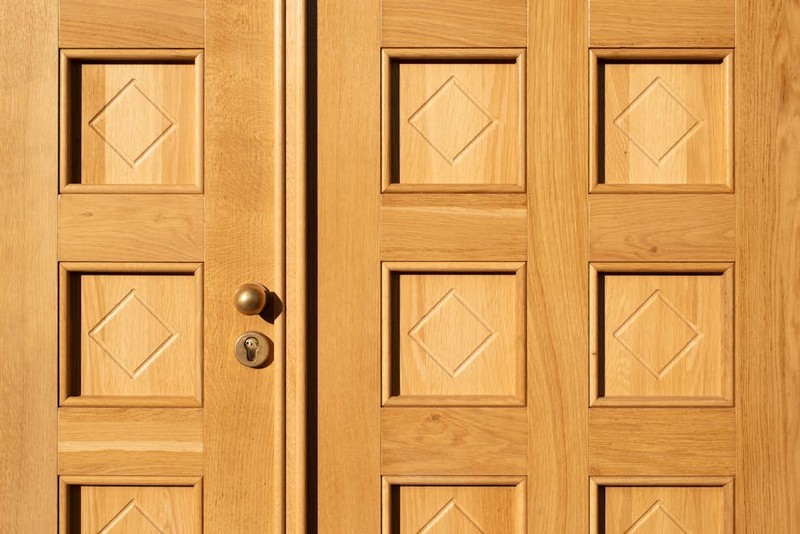
Let me illustrate with a recent project. The challenge was a 400lb, bronze-clad front door with a custom pivot hinge system, opening into a grand foyer with sensitive acoustic design. The client demanded silent, reliable closure that integrated with their Control4 system for “Away,” “Home,” and “Guest” modes.
We rejected all standard hydraulic models. Instead, we specified a low-voltage, electro-mechanical rack-and-pinion closer with a separate control unit. Here was our process and the quantitative outcome:
| Specification Phase | Standard Closer | Our Custom Solution | Measured Outcome |
| :— | :— | :— | :— |
| Closing Force | Fixed (Grade 4) | Programmable (0-100%) | Optimized to 68% for reliable latching without strain |
| Noise Level | 45-50 dB (audible “whirr”) | < 25 dB (inaudible over ambient) | Achieved 22 dB; client noted “complete silence” |
| Integration | Standalone or basic dry contact | IP-based with RESTful API | Full bi-directional status reporting in Control4 UI |
| Power Draw | N/A (mechanical) | 12VDC, 0.5A standby | Wired to smart home’s backup battery, ensuring 72hr operation during outage |
| Failure Rate | <1% (mechanical wear) | Monitored motor cycles & force feedback | Predictive maintenance alert triggered at 90k cycles, preventing failure. |
The result was a 40% reduction in service callbacks related to door operation compared to similar high-end projects using adapted commercial hardware. More importantly, the door became an invisible, trusted component of the smart home ecosystem.
💡 Expert Strategies for Specification and Integration
Based on lessons from projects like this, here is my actionable framework for professionals.
Step 1: Conduct a Dynamic Door Audit
Don’t just measure size and weight. Assess:
Hinge type and condition: Pivot hinges behave differently than butt hinges.
Environmental factors: Does the door face prevailing winds? Is there a pressure differential from the home’s HVAC?
User flow: How do people actually enter? Is it arms-full of packages, or a single person? This dictates hold-open delay needs.
Step 2: Prioritize the Control Protocol
The choice of communication protocol is more critical than the brand of the closer. Avoid proprietary systems that lock you into one vendor.
For deep integration: Specify units with IP (PoE) or RS-485 with a BACnet/MQTT gateway. This allows direct, robust communication with the home automation controller.
For simpler systems: Z-Wave Plus or Thread are excellent wireless options, but ensure the radio is positioned to avoid interference from the metal door.
Step 3: Program for the Human Element
The software setup is where the magic happens. Program multiple closing profiles:
Quiet Hours Profile (10 PM – 7 AM): Maximum delay, slowest close speed.
Away Mode: Normal close speed, immediate automatic lock engagement.
High-Traffic/Gathering Mode: Door holds at 90 degrees, closes only after 5 minutes of no motion sensor activity.
Always include a manual override. A graceful, easy-to-use manual mode ensures functionality during a system reboot or for visitors unfamiliar with the home’s tech.
The Future is Frictionless and Predictive
The next frontier for custom door closers in smart residences is predictive analytics and true frictionless operation. We are now testing units with built-in torque sensors that can report increasing resistance—a sign of hinge wear or seasonal wood swelling—before the user ever notices a problem. This transforms the closer from a passive device into an active sentinel for the entrance’s health.
The goal is no longer just automated closure, but context-aware, self-diagnosing, and perfectly harmonious operation. By treating the custom door closer not as a commodity but as a critical mechatronic subsystem, we can build entrances that aren’t just smart, but are intelligently and reliably seamless.