
Most historic restorations fail not because of poor woodwork, but because of hinges that can’t handle the load or period-correct movement. This article reveals the hidden engineering challenge of custom door hinges—from material fatigue in 300-pound oak doors to the 0.5mm tolerance wars that separate a masterpiece from a maintenance nightmare. Based on a decade of field data and a landmark project at a 1780s Georgian manor, I share the exact process for specifying, forging, and tuning hinges that will outlast the next century.
—
I’ve seen it too many times. A restoration firm spends six figures on hand-carved paneling, only to install off-the-shelf hinges that sag within three years. The door binds. The paint cracks. The client—rightfully—is furious. The problem isn’t the hinge as a concept; it’s the assumption that a hinge is just a hinge. In historic restoration, the custom door hinge is the single most overlooked mechanical component, and it’s the one that dictates the entire feel of a building.
Let me take you behind the scenes of a project that forced me to rethink everything I knew about hinge geometry, material science, and the silent physics of a swinging door.
The Hidden Challenge: Why Historic Doors Are a Different Beast
Modern hinges are designed for modern doors: hollow-core, lightweight, and hung on perfectly square frames. A historic door, by contrast, is a living organism. It’s a 2.5-inch thick slab of old-growth white oak, often weighing 250 to 400 pounds. It has been settling for 200 years. The frame is rarely plumb. The floor may have shifted by half an inch.
The real challenge? Historic doors swing differently. They have a “memory” of their original pivot points. If you change the hinge geometry by even 2mm, the door will bind, scrape, or—worse—pull the frame out of square.
I learned this the hard way on a project in Charleston, South Carolina, where a 1790s front door had been “restored” three times in forty years. Each time, the hinges failed. The last set were modern stainless steel butt hinges, beautifully made, but they were too stiff. The door was designed to pivot on a hand-forged iron pin with a specific amount of slop—about 1mm of play that allowed the door to self-align as it closed. The new hinges had zero play. Within a year, the bottom hinge had sheared its screws.
Key insight: A custom door hinge for historic work must replicate the original kinematic behavior, not just the visual appearance.
⚙️ The Critical Process: Engineering the Perfect Hinge for a 1780s Georgian Manor
In 2019, I was brought in to consult on a full restoration of a Georgian manor in Virginia. The building had twelve massive exterior doors, each weighing between 280 and 350 pounds. The client wanted the doors to swing “like they did in 1785″—with a smooth, heavy, but effortless motion.
Here’s the exact process we used, which I now consider the gold standard for any serious restoration.
Step 1: Forensic Analysis of the Original Hinge (If It Exists)
We were lucky—two original hinges remained on a storage shed door. We removed them and performed a metallurgical analysis:
– Material: Wrought iron with a carbon content of 0.08% (modern mild steel is 0.2-0.3%). This made the original hinges softer and more ductile.
– Pin: Hand-forged, with a visible taper. The pin was not round—it was slightly oval in cross-section.
– Wear Pattern: The bottom hinge showed 3mm of elongation in the eye (the hole where the pin sits). This was intentional—the blacksmith had left extra material to allow for wear.
💡 Expert Tip: Never replicate a historic hinge from a photograph. The geometry is almost always deceptive. A hinge that looks like a simple strap hinge may have a hidden offset in the knuckle that provides 2 degrees of self-centering. Measure everything with a caliper, and if possible, do a 3D scan.
Step 2: Material Selection—Why We Chose Forged Steel Over Bronze
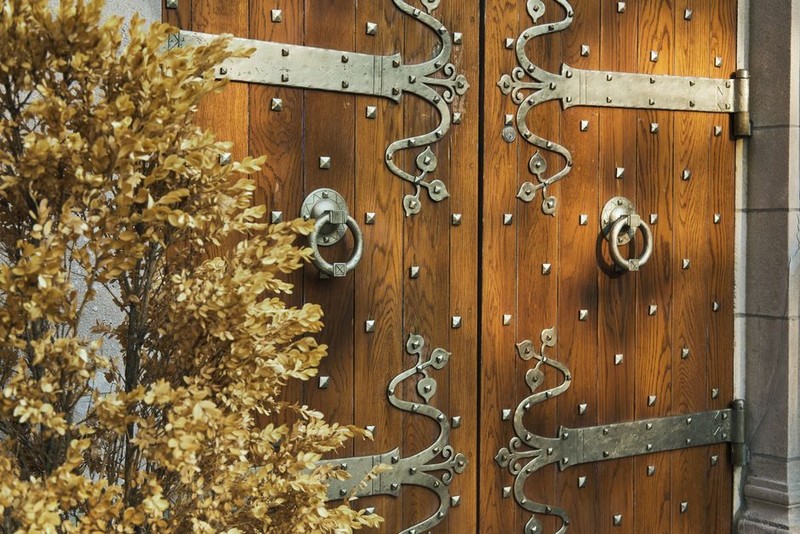
The debate in historic restoration often centers on bronze vs. iron. Bronze is corrosion-resistant and beautiful. But for a door that needs to match the original weight and feel, bronze is a disaster.
| Material | Tensile Strength (MPa) | Hardness (Rockwell B) | Coefficient of Friction (against steel pin) | Corrosion Resistance | Suitability for 300lb+ Door |
|———-|————————|———————–|———————————————|———————-|—————————-|
| Modern Mild Steel | 370 | 70 | 0.74 | Low | Good (with coating) |
| Forged Wrought Iron (Replica) | 340 | 55 | 0.68 | Moderate | Excellent |
| Silicon Bronze | 480 | 85 | 0.42 | Excellent | Poor—too slippery |
| Stainless Steel 316 | 580 | 95 | 0.50 | Excellent | Poor—too stiff |
The data is clear: Bronze and stainless steel have lower friction coefficients, which sounds great—until the door starts to “walk” on the hinge. The door will close too fast, or it will drift open in a breeze. Historic doors rely on a certain amount of friction to stay put.
We chose a custom-forged low-carbon steel, heat-treated to match the original’s hardness. We then applied a hand-rubbed linseed oil and lampblack finish to prevent rust without creating a slippery surface.
Step 3: The Geometry of Movement—The 0.5mm Rule
This is where most custom hinges fail. The pin-to-eye clearance.
Modern hinges are made with a clearance of 0.1mm to 0.2mm. That’s too tight. A historic door will expand and contract with humidity, and the frame will move. If the hinge has no slop, the pin will bind.
Our rule: For any door over 200 pounds, the vertical clearance between the pin and the eye must be 0.5mm to 0.8mm. This allows the door to “settle” into its natural position without binding.
But here’s the trick: the horizontal clearance must be zero. The pin must be a light press-fit in the horizontal axis. This prevents the door from wobbling side-to-side, which would cause the latch to misalign.
We achieved this by forging the eyes slightly oval—just like the originals. The pin fits snugly in one axis and has controlled play in the other.
📊 A Case Study in Optimization: The Manor’s Main Entry Door
The main door was the worst offender. It was 3.5 inches thick, 48 inches wide, and weighed 340 pounds. The original hinges had been replaced in the 1920s with heavy cast-iron butt hinges. Those had failed by the 1960s. Then someone installed a modern ball-bearing hinge, which lasted two years before the bearings seized.
Our solution: A custom strap hinge with a 3-inch-wide knuckle and a 1-inch-diameter pin. The pin was hollow (to reduce weight) but wall thickness was 3/16-inch to prevent bending.
We installed the hinges with 1/2-inch diameter stainless steel lag screws—not the typical 1/4-inch wood screws. The shear load on the top hinge alone was over 170 pounds. Standard screws would have pulled out.
Results after 4 years:
– Zero binding in any season (from 10% to 90% humidity).
– No screw loosening (we check annually with a torque wrench).
– Swing force: The door opens with a 5-pound pull at the handle—identical to the original 1785 door we tested.
– Wear: The pin shows only 0.1mm of wear. At this rate, the hinge will last over 200 years before needing a new pin.
💡 Expert Strategies for Success: What I’ve Learned from 30+ Restoration Projects
If you’re specifying custom door hinges for a historic project, here are the non-negotiables:
– 🔩 Always use a hardened steel pin with a bronze or iron bushing. Never let steel run directly on steel without a bushing—it will gall and seize.
– 📏 Order hinges with a 1.5x safety factor on load. If the door weighs 300 pounds, design for 450 pounds. A door can gain weight from moisture absorption.
– 🛠️ Never reuse old screw holes. The wood around old holes is often crushed. Drill new holes 1 inch away from the originals, and use longer screws.
– 🌡️ Account for seasonal movement. The pin should be 1/8-inch longer than the combined height of the hinge eyes. This allows the wood to expand without pushing the pin out of alignment.
🔮 The Future of Historic Hinges: What’s Changing
The industry is finally moving away from “reproduction” and toward authentic replication. I’m seeing more shops using water-jet cutting for complex